| ☯✞ Follow for more Soft Grunge ✞☯ |
Tuesday, March 25, 2014
The Life and Death of Grunge
Tuesday, February 18, 2014
The MTV Generation
Wednesday, March 7, 2012
Hole
“Violet,” “Doll Parts,” “Celebrity Skin”
Who Are They?
An often-overlooked grunge band with a tenacious cherry bomb of a frontwoman.
Hole formed in 1989 after guitarist Eric Erlandson responded to an advertisement in the punk rock fanzine Flipside. The ad simply said, “I want to start a band. My influences are Big Black, Sonic Youth, and Fleetwood Mac.” The inquirer? Some chick called Courtney Love.
The band’s first rehearsals basically consisted of Courtney, Eric, and original bassist Lisa Roberts playing something noisy while Courtney and Lisa started screaming their poetry for two or three hours. That is how magic happens, people.
Once they picked up a drummer and a third guitarist, Hole started playing shows in nightclubs and seedy bars in Los Angeles. After a couple lineup changes, the band released their debut album, Pretty On the Inside, in 1991. Courtney wanted desperately for Sonic Youth’s Kim Gordon to produce the album, so she sent Kim a letter, a Hello Kitty barrette, and copies of Hole’s early singles. Kim agreed, probably because of the Hello Kitty barrette. Who wouldn’t say yes to that?
Pretty On the Inside received high praise from underground critics, especially in the UK where Hole did an extensive tour with Daisy Chainsaw and Mudhoney. Spin loved it, ranking it in their “20 Best Albums of the Year” list.
In later years, Courtney panned the album and referred to it as unlistenable. Whatever you say, Courtney.
During the Pretty On the Inside tour, Courtney became romantically involved with Kurt Cobain. The two would eventually become the notorious grunge power couple we all know today, finally getting married in February 1992.
Once Kurt and Courtney welcomed daughter Frances Bean into the world later that year, Courtney wanted to change up Hole’s sound. She wanted to transition from the gritty punk rock style to a more melodic, pop-influenced rock format. Bassist Jill Emery and drummer Caroline Rue didn’t want any part of a poppy version of Hole, so they split.
Frustrated and desperate for a stable lineup, Courtney ran another ad, this time more specific. It read, “[I want] someone who can play ok, and stand in front of 30,000 people, take off her shirt and have ‘fuck you’ written on her tits. If you’re not afraid of me and you’re not afraid to fucking say it, send a letter. No more pussies, no more fake girls, I want a whore from hell" (taken from Dirty Blonde: The Diaries of Courtney Love).
Drummer Patty Schemel and bassist Kristen Pfaff signed on in late 1992, and work on the new album began in 1993.
Meanwhile, our grunge power couple was riding a downward spiral into heroin addiction. Kurt and Courtney both checked into rehab in 1994, but Kurt checked out shortly after arriving there. He was found dead in his Seattle home in April 1994 of a self-inflicted gunshot wound to the head.
Hole’s second full-length album, Live Through This, was released just four days after Kurt’s death. Amidst the hysteria surrounding Kurt’s passing, Live Through This became a critical success. Singles “Violet,” “Doll Parts,” and “Miss World” exploded on MTV and alternative rock radio. Just goes to show that changing up your sound a bit can work wonders.
The Live Through This tour came to a halt early on when Kristen Pfaff died of an apparent heroin overdose. Hole pulled out of Lollapalooza that year and disappeared from the media spotlight, only to return in September 1994 with new bassist Melissa Auf der Maur.
Following the tour, Courtney scored a lead role in the 1996 film The People vs. Larry Flynt and Hole was put on the backburner.
The band’s third studio album, 1998’s Celebrity Skin, adopted a more pop-oriented sound. It received unanimously positive reviews while Courtney received nothing but hate. Acclaim for both Live Through This and Celebrity Skin was undercut by rumors that Kurt actually wrote both albums. The band collectively denied the allegations.
In 1999, Melissa Auf der Maur quit Hole to become the touring bassist for Smashing Pumpkins. Patty Schemel bowed out before the release of Celebrity Skin, and her replacement, Samantha Maloney, left with Melissa. Eric and Courtney officially disbanded Hole in 2002.
Where Are They Now?
Living on through Courtney Love.
After the split, everyone took on different projects. Courtney released a solo album in 2004 called America’s Sweetheart, Eric worked as a producer and session musician, and Melissa embarked on her own solo career.
In 2009, Courtney announced the reunion of Hole…without informing any of the original members.
Apparently she decided to release her second solo album, 2010’s Nobody’s Daughter, under the name Hole. Eric and Melissa were surprised by Courtney’s announcement, considering the fact that neither one of them had been invited to contribute to the record. Eric revealed that contractually no Hole reunion could take place without his involvement, so Nobody’s Daughter was technically a Courtney Love solo record.
Nobody’s Daughter received mixed reviews, with most critics concluding that Courtney is only as good as her collaborators.
But Why Hole?
Eric, Melissa, and Patty recently announced that they will reunite as Hole for a special show in Hudson, NY on April 8. Unfortunately, Courtney refused to take part. Instead, she’ll be working with the new “Hole” lineup on a new studio album.
What Does Sam Think?
Rant: This section will not be about Courtney Love’s relationship with Kurt Cobain. If you want to read about Nirvana, head on over to my entry on Nirvana. Hole is a completely different band and should be treated as such. And Courtney is so much more than Kurt Cobain’s widow. End rant.
So I obviously dig the grunge scene in the ‘90s. Hole was the perfect mix of down and dirty grunginess and pro-feminist riot grrrl edginess. Pretty On the Inside is a perfect example of this mesh. It’s this visceral, in-your-face monster of a record that definitely leaves an impression.
But the band didn’t stick to that sound. Professionally, that would a good option. If they had chosen to churn out another Pretty On the Inside, we wouldn’t have Live Through This, which is honestly one of the best albums of the ‘90s.
Live Through This is made of blood, sweat, and tears. While it’s not as aggressive as its predecessor, it still has that raw intensity of a woman scorned. It also has a softer side, one that puts Courtney into a vulnerable position. Look at “Doll Parts.” The lyrics are so incredibly personal. When you add in Kurt’s death, that song just becomes heart wrenching.
Celebrity Skin took the pop aesthetic a little too far for me, though. Yeah, the title track is great, but without all the snarling and distortion, it just lacks depth. And don’t even get me started on Nobody’s Daughter.
Okay, get me started. Nobody’s Daughter isn’t a terrible album ("Skinny Little Bitch" is a pretty rad track). It’s decent, but it kind of sounds like a different band. Oh, wait. It is a different band. It’s Courtney Love and some other guys. That’s not really Hole, just like whatever Billy Corgan is doing right now isn’t really Smashing Pumpkins.
I think the world would be a better place if Hole’s original lineup got back together to record an album, or at least go on tour. I mean, Courtney really hasn’t ruled that out yet. There’s still hope for angry young women everywhere.
-- Sam Boyer, reporting from the '90s.
Tuesday, April 5, 2011
Nirvana
“Smells Like Teen Spirit,” “Come As You Are,” “Heart-Shaped Box”
Who Are They?
Now honestly, if you haven’t heard of Nirvana, just leave now. No excuses.
Innovators. Definers of grunge culture. This blog’s namesake. When discussing ‘90s music, Nirvana is usually the first band to come to mind. “Smells Like Teen Spirit” regularly graces “Greatest ‘90s Songs” lists as the #1 choice, and 1991’s Nevermind is often cited as one of the greatest albums of all time. Twenty years ago, Nirvana was the biggest band on the face of the earth. And Kurt Cobain realized how much he absolutely hated that fact.
Nirvana didn’t actually start as Nirvana. Before Kurt became good buddies with bassist Krist Novoselic in 1987, he was involved in a short-lived project with Buzz Osborne, founding member of The Melvins. This project became known as Fecal Matter. Catchy, eh?
After such name considerations as Pen Cap Chew and Ted Ed Fred, Kurt and Krist settled on Nirvana and proceeded to go through drummers like tissues. Aaron Burckhard, Dale Crover, Dave Foster, and Chad Channing took turns sitting behind the drum kit. Chad stuck around long enough to lend his skills on the band’s debut, Bleach (which was recorded for a mere $606.17).
After touring being Bleach, Nirvana went back to the studio to work with the almighty Butch Vig. During these sessions, Chad became increasingly frustrated about not being involved with the songwriting. So he ditched the band and Kurt and Krist were left to recycle drummers. Following repeated recommendations from Sonic Youth’s Kim Gordon, a relatively unknown musician by the name of Dave Grohl auditioned. Turns out he was pretty damn talented.
The sessions with Vig produced Nevermind, and “Smells Like Teen Spirit” was chosen as the album’s first single. And all was right with the world. Angsty teenagers finally had a theme song and bands like Poison and Twisted Sister were left in the (glittery) dust.
As Nirvana began to conquer the world, Kurt quickly became disenchanted with his newfound fame. He was the anti-star, which ironically just made him even more famous. He resented being compared to other rock idols and even refused to ride in a limo to his own performance on Saturday Night Live. By 1992, Kurt had begun to withdraw from the rest of the band, causing Dave and Krist to become closer.
Incesticide, a compilation album, was released in 1992. Because everyone was still drooling over Nevermind, Incesticide wasn’t heavily promoted (which is a shame because there are some gems on that album).
In an attempt to distance themselves from the glossy sound of Nevermind, Nirvana chose to work with underground producer Steve Albini to record In Utero. The album was miles away from its predecessor. Christopher John Farley of Time put it quite simply: “Nirvana hasn’t gone mainstream, though this potent new album may once again force the mainstream to go Nirvana.”
The band appeared on MTV Unplugged in late 1993, and in typical Nirvana fashion, opted not to play their most popular songs. Instead, they performed several covers, most notably a rendition of David Bowie’s “The Man Who Sold the World.”
After a suicide attempt in early 1994, Kurt was convinced to commit himself into rehab, but escaped after less than a week. On Friday, April 8, he was found dead of a self-inflicted shotgun wound to the head in his Seattle home. And so ends the legend of Nirvana.
Where Are They Now?
Gone, but the music lives on.
Because of the tragic loss of their front man, Dave and Krist thought it only appropriate to retire Nirvana for good. Of the two, Dave found the most success. He formed Foo Fighters in 1994, and also teamed up with Josh Homme to record with Queens of the Stone Age and Them Crooked Vultures (for the full story/my witty banter on Foo Fighters, click here).
Krist continued with music for a short time, forming various short-lived bands with old friends. He became a full time member of the band Flipper in 2006, but departed two years later. Krist is also active in politics as an elected State Committeeman, most famously supporting libertarian Republican Congressman Ron Paul in the 2008 Presidential election.
Dave and Krist recently teamed up on Foo Fighters’ upcoming album Wasting Light. Krist plays bass and accordion on the song “I Should Have Known.”
But Why Nirvana?
This week marks the 17th anniversary of Kurt Cobain’s death, which still remains one of the most devastating tragedies in music history. Also, Nevermind will be celebrating its 20th birthday later this year. So break out the flannel and light a candle for Kurt.
What Does Sam Think?
I’m just gonna put it out there: Nirvana is one of my favorite bands of all time. Whether you like them or not, there’s no denying how much of an impact they made in the music industry. Without “Smells Like Teen Spirit,” without Kurt’s sense of anti-fashion, without all that feedback, a lot of the younger bands today wouldn’t exist. So yeah, they’re kind of a big deal.
But I’m sure a lot of people wonder how the hell Nirvana got so big. Some write off Nirvana’s sound as just plain noise. I can see where you’re coming from, anonymous music-basher. Kurt definitely wasn’t the greatest guitarist in the world, and he really couldn’t sing either. But that didn’t matter. It was his songwriting that caught people off-guard. He had the power (and the background story) to engage the social misfits of the world. To them, he was the ultimate symbol of despair and alienation. His words reached kids some would deem unreachable, and, whether he liked it or not, Kurt became the ultimate idol.
But it’s not all about Kurt. Nirvana was a group, not just one man with a guitar. Without Krist, we wouldn’t have the tasty bass lines in “Sliver” and “Lounge Act.” Without Dave, we wouldn’t have the overall incredible drum work that glued everything together. It all sounded so wrong, but when everything was said and done, it just worked.
Nirvana took the raw energy from punk rock, injected some smoky metal undertones, and packaged it all together with a few simple chords. It sounds easy, sure. But if that’s the case, why didn’t someone else think of it first?
This band did what other bands wish they could do, and that’s introduce a whole new side to music that no one had experienced yet. Kurt, Krist, and Dave single-handedly defined an entire decade. What have you done lately?
--Sam Boyer, reporting from the ‘90s.
Tuesday, March 8, 2011
Soundgarden
“Black Hole Sun,” “Spoonman,” “Burden in My Hand”
Who Are They?
One of the “Big Four” grunge acts of the early ‘90s. (Has anyone coined the term “Big Four Grunge Acts?" If not, I’m claiming it. Intellectual property!)
Think all the way back to 1991. The terrible fad of ‘80s glam metal had been crushed by an army of angsty, disheveled kids from Seattle. Flannel and unwashed hair replaced spandex and the noxious fumes of too much hairspray. Leading the movement were the Big Four Grunge Acts©: Nirvana, Pearl Jam, Alice in Chains, and Soundgarden.
This epic tale usually describes grunge just kind of appearing out of thin air, citing Nirvana as the band that started it all. You know how it goes: “Then ‘Smells Like Teen Spirit’ came out and everything just changed, man.” Actually, man, Soundgarden had already formed long before Kurt Cobain even thought of the name Nirvana.
Chris Cornell and the former bassist of Hiro Yamamoto formed a little band called The Shemps in the early ‘80s, which later evolved into Soundgarden. The original lineup featured Chris on drums and vocals, Hiro on bass, and Kim Thayil on guitar. Scott Sundquist rescued Chris from the difficulty of pulling double duty, but bowed out after playing a few gigs. Matt Cameron (formerly of Skin Yard) replaced him, and that’s when people first started to take notice.
Soundgarden signed to Sub Pop in 1987, released a couple of E.P.s, switched to SST Records for their debut album Ultramega OK (which earned them a Grammy nod for Best Metal Performance), then made the biggest underground band faux pas by signing to major label A&M Records. They were basically excommunicated from the Seattle scene, and even Hiro Yamamoto ditched them. One album and two bassists later, Soundgarden settled into an established lineup (now with Ben Shepherd on bass) and stormed into the ‘90s with 1991’s Badmotorfinger.
Although Badmotorfinger was overshadowed by Nirvana’s Nevermind, Chris and the boys found mainstream success a few years later with 1994’s Superunknown. Their most popular single “Black Hole Sun” helped the album to debut at #1 on the Billboard 200 chart and earned the band an MTV Video Music Award, plus two Grammys.
The slightly less heavy Down on the Upside didn’t see as much success as Superunknown, and Soundgarden officially decided to call it quits in 1997.
Where Are They Now?
Back together and gaining momentum.
After the breakup, the foursome went their separate ways. Chris released a solo album in 1999 (as most front men like to do when their original bands dissolve). In 2001, he teamed up with then-former members of Rage Against the Machine Tom Morello, Tim Commerford, and Brad Wilk to form the delightful supergroup Audioslave (yours truly saw them live twice!). Audioslave released three albums until they disbanded in 2007. Chris released two more solo albums, his most recent being the Timbaland-produced Scream.
Kim joined forces with punk royalty Jello Biafra (formerly of Dead Kennedys), former Nirvana bassist Krist Novoselic, and drummer Gina Mainwal for one show as The No W.T.O. Combo in 1999. He later contributed to projects by Steve Fisk, Dave Grohl, and the band Sunn O))).
Matt worked briefly with Smashing Pumpkins on their album Adore, then became Pearl Jam’s permanent drummer in 1998, recording four albums with them.
Ben turned his attention back to his side project Hater, originally started in 1993 when he was still with Soundgarden.
On January 1, 2010, Chris alluded to a Soundgarden reunion on his Twitter, writing, “The 12-year break is over and school is back in session. Sign up now. Knights of the Soundtable ride again!” Only Chris Cornell can make a medieval reference and not sound like a geek.
The band played their first show since 1997 at the Showbox at the Market in Seattle on April 16, and after months of rumors, it was announced that they would appear at Lollapalooza in August. I can tell you from first-hand experience that the Lolla performance was AMAZING.
But Why Soundgarden?
“Black Rain,” a previously unreleased track and the band’s first single since 1997, was included on the compilation album Telephantasm: A Retrospective. Their first live album, Live on I5, will be released on March 22 (same day as Green Day’s live album, strangely. There’s a random plug for you). Oh, and there’s new material floating around, just in time for their first album in 15 years. But no big deal.
(Random thought: Does this video remind anyone else of Dethklok?)
What Does Sam Think?
First things first: Soundgarden really shouldn’t be considered a grunge band. Technically, the only real grunge band out of the Big Four was Nirvana. Soundgarden is more of a metal band, but not in the typical sense. There are grunge undertones, but the sound isn’t totally embraced. It’s…quasi-metal. Yeah, I just made up a genre. Sue me.
Genre speculation aside, this band’s talent needs to be recognized. Don’t compare them to Pearl Jam or Nirvana (I broke that rule, but that was for introductory purposes). Soundgarden sounds like nothing else. Listen to Superunknown in its entirety, and maybe skip over “Black Hole Sun” because we’ve all heard it so many times (that doesn’t mean it’s not a great song, though). One of the best Soundgarden songs is “4th of July,” simply because it’s dark, brooding, and just sounds like it comes from the depths of Hell.
But honestly, the best album has to be Badmotorfinger. It’s pure, feral, filthy music made of liquid gold and primal screams. I’m just gonna come out and say it: Chris Cornell has the voice of an angel. Seriously. Nuns cry when he opens his mouth. Put on “Jesus Christ Pose” and try to stop the hairs on the back of your neck from standing up.
Okay, I’m done gushing.
Anyway, words can’t express how excited I am about new Soundgarden material. The guys are taking it slow, which is actually a great idea. Chris told Spin that they’re “putting the music first.” In his own words: “We don’t have a schedule…The process of writing, recording, and being creative together is the most important thing, not meeting a deadline.” Aw, band love. Why can’t all bands do that? Actually, I take that back. I’m a pretty impatient fan. But I’ll wait just for Soundgarden.
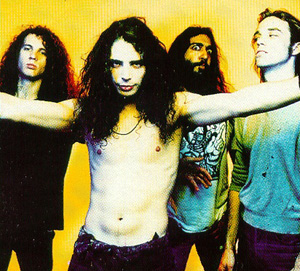
Now enjoy some faces that will haunt your dreams.
--Sam Boyer, reporting from the ‘90s.