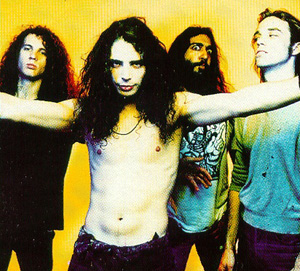
Showing posts with label soundgarden. Show all posts

Tuesday, March 25, 2014

The Life and Death of Grunge

Get ready for a doozy of an entry, readers. This week, I’m going to tackle an entire genre of music: grunge (the genre part is questionable). So let’s take a close look at the ‘90s phenomenon we all know and (possibly) love.

Where Did Grunge Come From?
Grunge (or the Seattle sound) emerged in--you guessed it--Seattle in the mid-‘80s. The term was first used in 1981 by Green River vocalist Mark Arm in a letter he wrote to Seattle zine Desperate Times. Mark was “criticizing” his first band, Mr. Epp and the Calculations, calling them “Pure grunge! Pure noise! Pure shit!”

But Mark admitted that he had snagged the term from Australia, and didn’t use it as the official name of the genre. It was Sub Pop founder Bruce Pavitt who actually popularized the term by dubbing the bands on his label as “grunge.”

Grunge as a genre was a result of Seattle’s isolated music scene. It evolved from the punk scene, inspired by bands like The Fartz, The U-Men and the Fastbacks. Bands outside the Pacific Northwest (Sonic Youth, Pixies, Dinosaur Jr.) also influenced the grunge scene, along with Black Flag’s change of pace on 1984’s My War.


How Would You Describe Grunge?
This genre definitely has a specific sound. It’s kind of a mix of hardcore punk, heavy metal and the general “alternative” sound.

Grunge is typically characterized by sludgy guitars, fuzz pedals, a ton of distortion and growly, almost incomprehensible vocals. It shares more in common with punk than anything else. The only differences between punk and grunge are tuning and tempo. And like punk, grunge puts on this air of not giving a fuck about melodies while still having discernable melodies.

Most grunge songs address some form of alienation or apathy. There isn’t much rebellion behind tunes like “Smells Like Teen Spirit” and “Black Hole Sun.” But of course there’s some humor behind all that lethargy. Soundgarden’s “Big Dumb Sex” satirizes hair metal (fairly accurately, too).

Jon Wiederhorn of Guitar World once wrote, “So what exactly is grunge? Picture a supergroup made up of Creedence Clearwater Revival, Black Sabbath and The Stooges, and you’re pretty close.” And you know what? That’s a pretty accurate statement.


So Who’s Grunge Again?
Some of the first bands labeled as grunge were Green River, Soundgarden, Melvins, Malfunkshun and Skin Yard. Notice that Nirvana is nowhere in that lineup because they came after the establishment of the genre.

At first, the term “grunge” only applied to bands from the Seattle area, including Alice In Chains, Mudhoney, Screaming Trees, Pearl Jam and yes, Nirvana. As the Seattle sound began to creep out of the Pacific Northwest, similar-sounding bands (not necessarily copycats) fell under the same label, including Babes in Toyland and Stone Temple Pilots.

People like to argue over which bands are really grunge and which bands are “posers.” (Do people still use the term “poser,” or is that just a middle school thing?) Though I believe it’s just plain silly to be so concerned over a certain band’s genre, it’s my understanding that only bands that came out during a specific time frame (and a specific area, to a certain extent) can be classified as grunge.

As a serious ‘90s scholar (can I put that on my résumé?), I would put the official grunge reign between 1984 and 1994. It all started with Green River and Soundgarden, and officially ended with Kurt Cobain’s suicide in 1994.

Anything after 1994 is post-grunge, a more radio-friendly version of its gnarly predecessor. Post-grunge bands include Bush, Collective Soul, Foo Fighters and Creed (all of which I enjoy, so sue me).


Is Grunge Dead?
Yes. Yes, it is.

Grunge as a music genre has been dead since 1994 and I will fight anyone who disagrees with me. Though I don’t really like to make it seem as if Kurt Cobain was the only guy in the scene who mattered, his death definitely marked the end of an era. Sure, other Seattle bands went on to release more albums (Pearl Jam has had a pretty lucrative career), but grunge was done for.

So what happened?

Well, the alternative music scene of the ‘90s was exploding with a variety of bands hitting it big. As grunge’s popularity began to wane, it was usurped by post-grunge, Britpop and pop-punk. Everything suddenly became more radio-friendly and much less angsty. Britpop bands brought back keyboards, post-grunge bands asserted some masculinity and pop-punk bands picked up where The Ramones left off. Nobody was jamming to songs like “I Hate Myself and I Want to Die” anymore.

Blur frontman Damon Albarn commented on grunge’s decline in a 1993 interview, saying, “If punk was about getting rid of hippies, then I’m getting rid of grunge.” And a year later, it was all over.

Another contributing factor to this genre’s demise is its quick and ruthless commoditization. By the time Nirvana found its way into the mainstream, Kurt’s hobo-chic style was already being sold to Generation X. When the dress code becomes more important than the music, you’ve got a problem on your hands.

MTV also had a hand in destroying the scene. The rise of music videos meant the rise of exposure, and ultimately the rise of an entire culture based on television. MTV sold a product, and that product was alternative culture. (If you’re interested in a more in-depth analysis of MTV in the ‘90s, take a peek at this entry.)
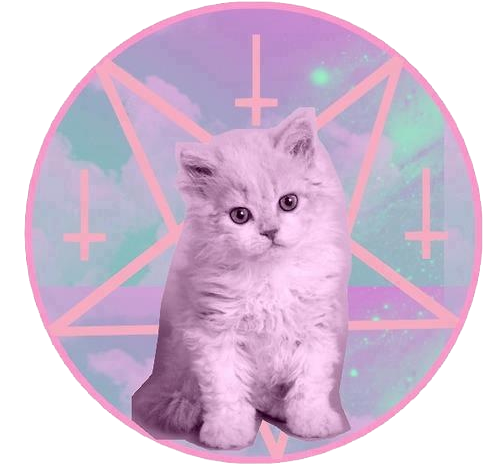
☯✞ Follow for more Soft Grunge ✞☯
Nowadays, grunge is kind of a punch line. Even I tend to joke about feeling “grunge” on a daily basis. And with the rise of Internet culture and the burgeoning market of ‘90s nostalgia, we’ve strayed so far from the original meaning behind the term. There’s even this weird subculture lurking on Tumblr that labels itself as “soft grunge.” (Spoiler: it has nothing in common with ‘90s grunge and it’s kind of hilarious.)

Grunge was a fad that ended at an appropriate time, as most fads tend to do. You don’t have to like it, but you have to admit it had a huge impact on popular culture. So don’t cry because it ended, dear readers. Smile because it happened. And maybe cry a little because Kurt Cobain died 20 years ago this month.


-- Sam Boyer, reporting from the ‘90s

Tuesday, May 17, 2011

Pearl Jam


Sound Familiar?

“Jeremy,” “Even Flow,” “Better Man”

Who Are They?

Arguably the most successful (and radio-friendly) band of the Big Four Grunge Acts©.

It all started with Stone Gossard, Jeff Ament, and a little band called Green River in the mid-‘80s. When that project disbanded, Stone and Jeff teamed up with Andrew Wood to form another little band called Mother Love Bone. After Andrew’s unfortunate death in 1990, Mother Love Bone called it quits and Stone and Jeff began jamming with prospective Pearl Jammer Mike McCready. Then they realized that not having a drummer or a singer was kind of counterproductive.

Cue gas station employee Eddie Vedder. Eddie was already the lead vocalist for a local band called Bad Radio when he received a demo tape from Stone and the gang. He recorded vocals for three songs (including a little ditty called “Alive”) and sent the tape back. Stone, Jeff, and Mike’s collective eargasm resulted in Eddie's being flown to Seattle, where he auditioned (was there really any need for an audition?) and joined the band within a week.

Before Pearl Jam took off, Soundgarden frontman Chris Cornell approached Stone and Jeff with the intention of collaborating on a few tribute songs for Andrew Wood. This project ended up as the short-lived band Temple of the Dog. Eddie and Soundgarden/future Pearl Jam drummer Matt Cameron also joined in. So before we had Pearl Jam, we had a pretty rad supergroup (which I guess wasn’t really a supergroup at the time because nobody had any idea who Eddie Vedder was).

But back to the Pearl Jam chronicles. When the boys finally settled on Dave Krusen as their drummer, they needed a name. Mookie Blaylock, anyone? No? Well, that was their first choice. Unfortunately, the name was trademarked (by a basketball team, if you’ll believe it), so Pearl Jam was used instead.

As the band began to record their landmark debut Ten in 1991, Dave decided to check into rehab. Matt Chamberlain replaced him, but ended up leaving after only a handful of shows to join the Saturday Night Live band. Dave Abbruzzese stepped in as a replacement for the rest of the tour.

When Ten was released (the same month as Nirvana’s Nevermind), sales were slow, but eventually exploded by the second half of 1992. The album stayed on the Billboard charts for more than two years and success came in wave after luxurious wave.

But Pearl Jam began to grow uncomfortable with all the popularity, especially Eddie. Tensions between the band and their label mounted when the boys refused to make a video for “Black.” When Cameron Crowe asked them why for his Rolling Stone article, Jeff explained, “Ten years from now, I don’t want people to remember our songs as videos.” (This is kind of ironic considering the band’s biggest single, “Jeremy,” spawned an intensely controversial music video).

Eddie and the gang continued to stick it to the man when they boycotted Ticketmaster for adding a service charge to tickets for their shows. They refused to be seen as a commercial product, so they stopped making music videos and releasing singles.

But not everyone in the group agreed with all this boycotting business. Dave was wary of the Ticketmaster nonsense, so he was promptly dismissed from the band after Vitalogy was recorded. Former Red Hot Chili Peppers drummer Jack Irons replaced him.

The Vitalogy tour ended being a disaster because of the Ticketmaster fiasco. Surprisingly (or maybe not), no other bands joined Pearl Jam in the boycott, and they were forced to play shows outside of the US for the next three years. Apparently Ticketmaster is a sponsor for virtually every venue in America. Weird, right?

No Code and Yield did not come even remotely close to the success of Ten or Vs., although the single “Do the Evolution” from Yield was accompanied by the band’s first music video since 1992.

As the ‘90s came to a close, Jack ditched Pearl Jam and was replaced by Matt Cameron (who was initially temporary, but became a permanent member because, hey, what else are you gonna do when a band like Soundgarden breaks up?)

Where Are They Now?

Still fighting the good fight and selling out stadiums (even the ones affiliated with Ticketmaster).

In 2000, Pearl Jam released Binaural, an experimental effort with some pretty dark lyrics. The somber aura surrounding the album came to a head when nine fans were crushed underfoot and suffocated to death at the Roskilde Festival in Denmark.

That same year, the band celebrated their tenth anniversary with a three-hour set at the MGM Grand in Las Vegas. After ten years together, it was time for a break.

Fast-forward one year. Pearl Jam went back to the studio to record Riot Act and also released a few b-sides for use in movies like Big Fish.

Fed up with their previous label’s shenanigans, the band made the decision to move to J Records to release their self-titled album in 2006. During the tour in support of Pearl Jam, the boys headlined both Lollapalooza and Bonnaroo. That’s right. Two major festivals. In the same year.

Their latest album, Backspacer, was released in 2009, along with a video for the album’s first single “The Fixer,” directed by Cameron Crowe. (Note to journalists: If you write a story about Pearl Jam for a major music magazine, you will be able to direct one of their music videos. This may or may not be true.)

But Why Pearl Jam?

Eddie and the boys are celebrating their 20th anniversary this year with a Labor Day festival (might I suggest the name Pearl Jamapalooza 2011?). It will also feature Queens of the Stone Age, Mudhoney, and various other acts. Oh, and there’s talk of a new album soon. But we’ll just concentrate on the present (even though you’re probably all giddy with excitement about new Pearl Jam material now).

What Does Sam Think?

To be honest, I just consider myself a casual Pearl Jam fan. That is slightly problematic when it comes to seeing this band live (which I did).

You can’t be a casual fan at one of these concerts. Why? Because Pearl Jam plays for the die-hards, something most bands don’t really consider. Say you’re in a fairly successful band. You’ve had a few hits that earned some heavy airplay. You’re going to play those hits at each show because that’s what your fans want to hear. And everyone is happy because they know a couple songs during your set.

This is not what Pearl Jam does. Pearl Jam plays the deepest cuts imaginable and discards most of their biggest hits. You may still hear “Alive” and “Black,” but forget about “Jeremy.” That may never see the light of day again, outside of your iTunes library.

That being said, I can’t judge Pearl Jam too harshly since I’m not a die-hard fan. I do enjoy Ten, though (who doesn’t?). But if I had to rank the Big Four Grunge Acts© by how obsessed I am with them, Pearl Jam is at the bottom. That isn’t because I dislike the band. They do make great music. I’ve just kind of overlooked them because they didn’t jump out at me.

I can hear people calling blasphemy right now. I know critics pretty much fawn over Pearl Jam (kind of like Radiohead, but slightly more subdued), and they probably have good reason. I will admit that certain songs (“Better Man”) have successfully won me over, but Pearl Jam’s catalogue as a whole is kind of lukewarm to me.

Now feel free to pelt me with rocks and copies of Vs.

--Sam Boyer, reporting from the ‘90s.

Tuesday, March 8, 2011

Soundgarden


Sound Familiar?

“Black Hole Sun,” “Spoonman,” “Burden in My Hand”

Who Are They?

One of the “Big Four” grunge acts of the early ‘90s. (Has anyone coined the term “Big Four Grunge Acts?" If not, I’m claiming it. Intellectual property!)

Think all the way back to 1991. The terrible fad of ‘80s glam metal had been crushed by an army of angsty, disheveled kids from Seattle. Flannel and unwashed hair replaced spandex and the noxious fumes of too much hairspray. Leading the movement were the Big Four Grunge Acts©: Nirvana, Pearl Jam, Alice in Chains, and Soundgarden.

This epic tale usually describes grunge just kind of appearing out of thin air, citing Nirvana as the band that started it all. You know how it goes: “Then ‘Smells Like Teen Spirit’ came out and everything just changed, man.” Actually, man, Soundgarden had already formed long before Kurt Cobain even thought of the name Nirvana.

Chris Cornell and the former bassist of Hiro Yamamoto formed a little band called The Shemps in the early ‘80s, which later evolved into Soundgarden. The original lineup featured Chris on drums and vocals, Hiro on bass, and Kim Thayil on guitar. Scott Sundquist rescued Chris from the difficulty of pulling double duty, but bowed out after playing a few gigs. Matt Cameron (formerly of Skin Yard) replaced him, and that’s when people first started to take notice.

Soundgarden signed to Sub Pop in 1987, released a couple of E.P.s, switched to SST Records for their debut album Ultramega OK (which earned them a Grammy nod for Best Metal Performance), then made the biggest underground band faux pas by signing to major label A&M Records. They were basically excommunicated from the Seattle scene, and even Hiro Yamamoto ditched them. One album and two bassists later, Soundgarden settled into an established lineup (now with Ben Shepherd on bass) and stormed into the ‘90s with 1991’s Badmotorfinger.

Although Badmotorfinger was overshadowed by Nirvana’s Nevermind, Chris and the boys found mainstream success a few years later with 1994’s Superunknown. Their most popular single “Black Hole Sun” helped the album to debut at #1 on the Billboard 200 chart and earned the band an MTV Video Music Award, plus two Grammys.

The slightly less heavy Down on the Upside didn’t see as much success as Superunknown, and Soundgarden officially decided to call it quits in 1997.

Where Are They Now?

Back together and gaining momentum.

After the breakup, the foursome went their separate ways. Chris released a solo album in 1999 (as most front men like to do when their original bands dissolve). In 2001, he teamed up with then-former members of Rage Against the Machine Tom Morello, Tim Commerford, and Brad Wilk to form the delightful supergroup Audioslave (yours truly saw them live twice!). Audioslave released three albums until they disbanded in 2007. Chris released two more solo albums, his most recent being the Timbaland-produced Scream.

Kim joined forces with punk royalty Jello Biafra (formerly of Dead Kennedys), former Nirvana bassist Krist Novoselic, and drummer Gina Mainwal for one show as The No W.T.O. Combo in 1999. He later contributed to projects by Steve Fisk, Dave Grohl, and the band Sunn O))).

Matt worked briefly with Smashing Pumpkins on their album Adore, then became Pearl Jam’s permanent drummer in 1998, recording four albums with them.

Ben turned his attention back to his side project Hater, originally started in 1993 when he was still with Soundgarden.

On January 1, 2010, Chris alluded to a Soundgarden reunion on his Twitter, writing, “The 12-year break is over and school is back in session. Sign up now. Knights of the Soundtable ride again!” Only Chris Cornell can make a medieval reference and not sound like a geek.

The band played their first show since 1997 at the Showbox at the Market in Seattle on April 16, and after months of rumors, it was announced that they would appear at Lollapalooza in August. I can tell you from first-hand experience that the Lolla performance was AMAZING.

But Why Soundgarden?

“Black Rain,” a previously unreleased track and the band’s first single since 1997, was included on the compilation album Telephantasm: A Retrospective. Their first live album, Live on I5, will be released on March 22 (same day as Green Day’s live album, strangely. There’s a random plug for you). Oh, and there’s new material floating around, just in time for their first album in 15 years. But no big deal.

(Random thought: Does this video remind anyone else of Dethklok?)

What Does Sam Think?

First things first: Soundgarden really shouldn’t be considered a grunge band. Technically, the only real grunge band out of the Big Four was Nirvana. Soundgarden is more of a metal band, but not in the typical sense. There are grunge undertones, but the sound isn’t totally embraced. It’s…quasi-metal. Yeah, I just made up a genre. Sue me.

Genre speculation aside, this band’s talent needs to be recognized. Don’t compare them to Pearl Jam or Nirvana (I broke that rule, but that was for introductory purposes). Soundgarden sounds like nothing else. Listen to Superunknown in its entirety, and maybe skip over “Black Hole Sun” because we’ve all heard it so many times (that doesn’t mean it’s not a great song, though). One of the best Soundgarden songs is “4th of July,” simply because it’s dark, brooding, and just sounds like it comes from the depths of Hell.

But honestly, the best album has to be Badmotorfinger. It’s pure, feral, filthy music made of liquid gold and primal screams. I’m just gonna come out and say it: Chris Cornell has the voice of an angel. Seriously. Nuns cry when he opens his mouth. Put on “Jesus Christ Pose” and try to stop the hairs on the back of your neck from standing up.

Okay, I’m done gushing.

Anyway, words can’t express how excited I am about new Soundgarden material. The guys are taking it slow, which is actually a great idea. Chris told Spin that they’re “putting the music first.” In his own words: “We don’t have a schedule…The process of writing, recording, and being creative together is the most important thing, not meeting a deadline.” Aw, band love. Why can’t all bands do that? Actually, I take that back. I’m a pretty impatient fan. But I’ll wait just for Soundgarden.

Now enjoy some faces that will haunt your dreams.

--Sam Boyer, reporting from the ‘90s.