Showing posts with label '90s alternative. Show all posts

Wednesday, April 3, 2013

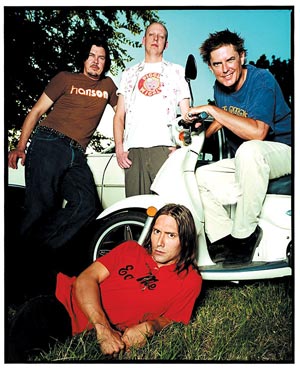
The Presidents of the United States of America


Sound Familiar?
“Lump,” “Peaches”

Who Are They?
Alternative weirdoes responsible for a song about a juicy fruit.

Formed in late 1993 in Seattle, The Presidents of the United States of America (hereon referred to as The Presidents because I’m lazy) got off to a quick start. They self-released a 10-song cassette called Froggystyle in December 1993 and signed to Seattle label PopLlama Records in 1994.

(Fun fact: Vocalist/bassist Chris Ballew actually plays a basitar, which is a six-string guitar with two bass strings. Guitarist Dave Dederer plays a guitbass, which has three guitar strings.)

The Presidents released their self-titled debut in 1995 and found massive mainstream success. Their biggest hit, “Peaches,” peaked at number eight on the US Billboard Hot Modern Rock Tracks chart (and is also known as the only song about peaches to break the top 10).

(Fun fact: “Peaches” is about a girl Chris had a crush on. He wrote the song after sitting under a peach tree she had in her yard while he waited for her to come home so he could finally tell her how he felt. Oddly sweet and stalker-ish.)

Amid a whirlwind tour and an appearance on MADtv in 1996, “Weird Al” Yankovic decided to release of parody of The Presidents’ song “Lump” called "Gump." You know you’ve made it when Weird Al parodies you.

The Presidents released the follow-up, II, in 1996. It peaked at number 31 on the Billboard 200 chart, but it wasn’t anywhere near as successful as the debut.

The band broke up in 1998 so Chris could spend more time with his family. The Presidents’ last release of the ‘90s was 1998’s Pure Frosting, which included new songs, covers and demos.

(Fun fact: A few songs from Pure Frosting appeared in TV shows and movies. "Man (Opposable Thumb)" was included in the Nickelodeon masterpiece Good Burger, a cover of “Video Killed the Radio Star” appeared on the soundtrack for The Wedding Singer and "Cleveland Rocks" ended up being the theme song for The Drew Carey Show.)

Although The Presidents didn’t release an album of new material until 2000, they collaborated with other artists, including Japanese band Shonen Knife and booty connoisseur Sir Mix-A-Lot. (Yes, the collab with Sir Mix-A-Lot is a real thing. The project was called Subset. Here’s proof. And it’s actually pretty rad.)

Where Are They Now?
Doing what ‘90s bands do best: performing at festivals.

The Presidents reunited in 2000 with a new single, “Jupiter.” The single actually became pretty popular, so the band released a brand new record, Freaked Out & Small, later that year. Critics loved it, but the album only sold 25,000 copies.

The band broke up again only to reunite again in 2004 to release Love Everybody. Dave Dederer left shortly after the album’s release and was replaced by Andrew McKeag, who played on the band’s most recent album, 2008’s These Are the Good Times People.

(Fun fact: The Presidents released a tribute song in 2011 at the Nintendo World launch event for Pokémon Black and White called "Can't Stop (Catchin' 'Em All)." I’m not sure if this is a major accomplishment or a major mistake.)

The Presidents have played various halftime football shows (no Super Bowl appearances, though) and plenty of festivals, but they haven’t had a single chart since 1998’s “Video Killed the Radio Star.”

But Why The Presidents of the United States of America?
The band will be performing at the Hop Farm Festival in the UK alongside My Bloody Valentine, Dinosaur Jr. and others. So if you can make it to Kent by July 5, be sure to catch their set!


What Does Sam Think?
My first introduction to The Presidents was probably during my sophomore year in high school. I was on my way to Disney World for my school’s traditional choir/orchestra trip, and when our Greyhound bus reached the Georgia state line in the wee hours of the morning, I put on “Peaches” in celebration.

That story really had nothing to do with my opinion of this band, but it’s a fun memory. So there.

Anyway, The Presidents are a fairly unique band in terms of instrumentation. I believe they’re the only band to use basitars and guitbasses, which really gives them a signature sound. I always wondered why their songs sounded so weird, and now I know. Also, if you’re a guitar geek and want to know more about these instruments, check out this GeoCities-esque website for more info.

The songs are a bit nonsensical, but they’re just so damn catchy. I’m just going to continue to praise “Peaches” here. I used to be obsessed with this song back in the day. I think it turned into an inside joke with one of my friends. We probably thought we were too cool because we listened to The Presidents. Or something like that.

I’d really like to see these guys put out a new album soon. I know they still make music, even in the form of questionable Pokémon songs. They still tour, for God’s sake. Unfortunately, they’ll probably always be billed as ‘90s nostalgia act. I’m just waiting for the day when they join the Summerland tour with Everclear.

Actually, that would be pretty rad. I’d pay to see that. You hear that, Presidents? I won’t think any less of you if you join Summerland. We’ll get drunk and sing “Peaches” together (because that’s what ‘90s bands do with their fans, right?).


-- Sam Boyer, reporting from the ‘90s.

Wednesday, March 13, 2013

Stone Temple Pilots


Sound Familiar?
“Plush,” “Interstate Love Song,” “Trippin’ on a Hole in a Paper Heart”

Who Are They?
Alternative radio mainstays and supposed grunge imposters.

As with most of the history of Stone Temple Pilots, there are two sides to the story of how Scott Weiland and bassist Robert DeLeo met: the band’s side and Scott’s side. The band said that Scott and Robert met at a Black Flag concert in 1986. The two began discussing their girlfriends, only to find out that they were dating the same woman. Instead of beating the shit out of each other in a jealous rage, the two developed a bond and decided to start a rock band (they broke it off with the girl shortly after).

Scott’s side of the story (as detailed in his autobiography, Not Dead and Not For Sale) was that he and his high school friend, Corey Hicock, pursued Robert after seeing him play live.

Personally, I prefer the band’s story (but I still love you, Mr. Weiland).

Scott, Robert, Corey and a drummer named David Allin formed a band called Swing, but after Corey and David ditched them, they grabbed drummer Eric Kretz and guitarist Dean DeLeo (Robert’s older brother). Dean flat out refused to be in a band called Swing, so the name changed to Mighty Joe Young.

The band recorded a demo tape in 1990 and played its first show supporting Henry Rollins. During the recording of the debut album, Scott and company got a call from a bluesman who claimed the name Mighty Joe Young.

In a scramble to find a new name, the band threw around various spins on the initials STP (inspired by the STP Motor Oil stickers). After briefly considering the name Shirley Temple’s Pussy, they settled on Stone Temple Pilots (thank God for that).

Stone Temple Pilots signed to Atlantic Records in 1992 and released their debut album, Core, the same year. Core was a huge success, but most critics accused the band of being “grunge imitators.”

Critics may have hated them, but STP still gained a loyal fan base. The band toured extensively with Rage Against the Machine and Megadeth and filmed an episode of MTV Unplugged.

(Fun fact: In a January 1994 Rolling Stone poll, STP was voted Best New Band by readers and Worst New Band by the magazine’s critics. Talk about discrepancy.)

Despite the critical backlash, STP won a Grammy for Best Hard Rock Performance for “Plush” and released the hugely popular Purple in 1994.

“Interstate Love Song” became the album’s biggest hit, topping the Mainstream Rock Tracks chart for 15 weeks.

Meanwhile, Scott was developing a serious heroin addiction. By the time STP’s third album, 1996’s Tiny Music…Songs from the Vatican Gift Shop, dropped, most of the tour had to be canceled due to Scott’s drug abuse. As a result, Tiny Music fell off the charts and STP’s popularity began to wane.

The band went on hiatus soon after the album’s release. During this time, Scott released a solo album (12 Bar Blues) and the rest of the band teamed up with Ten Inch Men front man Dave Coutts to perform as Talk Show.

STP regrouped in 1998 to record No. 4, released a year later.

Where Are They Now?
Still technically together, sans Scott Weiland (maybe?). We’ll get into that later.

STP’s success came roaring back with a little help from No. 4’s biggest single (and my favorite song), “Sour Girl.” (I highly recommend watching the super strange and oddly sexy music video.)

In 2001, the band released Shangri-La Dee Da, which ended up being a commercial disappointment. After an altercation between Scott and Dean on the final show of the Shangri-La Dee Da tour, Stone Temple Pilots officially disbanded.

Scott joined the ultra-cool supergroup Velvet Revolver in 2003, which consisted of former Guns N’ Roses members Slash, Matt Sorum and Duff McKagan, along with former Wasted Youth guitarist Dave Kushner. Velvet Revolver released two albums, 2004’s Contraband and 2007’s Libertad, before Scott officially left the band in 2008.

Stone Temple Pilots eventually reunited in 2008 after Scott and the DeLeo brothers settled their differences. The reunion tour officially kicked off at Rock on the Range in Columbus, Ohio the same year (I unfortunately didn’t get to witness that miracle firsthand).

After the release of a self-titled sixth studio album, things began to go sour again. Hopes for a 20th anniversary celebration for Core were dashed in 2012, and Scott was already looking to reunite with Velvet Revolver (which Slash immediately declined).

But Why Stone Temple Pilots?
As of February 27, 2013, Scott Weiland is no longer part of the band. Or maybe he is. I’m not quite sure at this point. Scott recently told TMZ, “STP is not broken up. It’s a whole thing to try to boost ticket sales.” And apparently he learned of his termination through the band’s official website, not directly from any other members. So is this for real, or is it really just a marketing ploy? It may be one of the great mysteries of the world.


What Does Sam Think?
Story time! Back in middle school, I was obsessed with Velvet Revolver (and I also had an embarrassingly huge crush on Scott Weiland, but that’s beside the point). Through Velvet Revolver, I became interested in Stone Temple Pilots. I had heard “Interstate Love Song” and “Plush” before, but I didn’t think of delving into the band’s discography until the formation of VR.

I know some people dislike this band for a variety of reasons. Some say these guys are “grunge wannabes” since their debut came out a year after Nirvana, Soundgarden, Alice In Chains and Pearl Jam’s breakthrough albums. And although Core does have a grungy feel to it, STP evolved past it. There’s a vast difference between Core and Purple, and an even bigger difference between Purple and No. 4. The band kind of adapted a more psychedelic sound in later albums, with a pinch of Southern rock influence (especially on “Interstate Love Song”).

But most people I know who dislike STP cite Scott Weiland as the weak link. I know I’m biased when I say this, but Scott is incredibly talented, and I think people look past that talent and concentrate on Scott’s drug abuse. His drug and legal escapades should not define him as a musician. I’ve read his autobiography (and you should, too) and I’ve come to realize that he’s a pretty troubled guy. You really can’t hold that against him.

So if you don’t like STP (which is perfectly okay), I hope it’s because of the music and not the man behind it.


--Sam Boyer, reporting from the ‘90s

Wednesday, February 27, 2013

Butthole Surfers


Sound Familiar?     “Pepper,” “Who Was In My Room Last Night?”

Who Are They?
One huge, chaotic, darkly comic drug trip of a band. (Side note: this entry is going to be filled with ridiculous fun facts because this band is just too weird, but in a good way.)

Like Bad Religion, Butthole Surfers got their start in the late ‘70s/early ‘80s in the hardcore punk scene. (Yes, believe it or not, there was a hardcore punk scene in San Antonio, Texas.)

Oddballs Gibby Haynes and Paul Leary met in the ‘70s at Trinity University in San Antonio and bonded over their shared taste in non-mainstream music. Gibby landed a job at an accounting firm, while Paul stayed in college to work on his degree.

(Fun fact: Gibby and Paul published a magazine in 1981 called Strange V.D., which was basically a collection of abnormal medical disorder photos, complete with hilariously fictitious explanations for each one.)

After playing a few shows in San Antonio with the sibling rhythm section of Quinn and Scott Mathews, the band (not known as Butthole Surfers at this point) bought a van and headed to California. During a concert in San Francisco, Dead Kennedys frontman Jello Biafra became a fan of the band and invited them to open for his band.

(Fun fact: The band didn’t settle on the name Butthole Surfers until its first paid gig. Prior to that, they performed under various aliases, including the Vodka Family Winstons, Ashtray Babyheads, Ed Asner Is Gay and The Inalienable Right To Eat Fred Astaire’s Asshole.)

Jello soon offered them a chance to record an EP and release it through his record label, Alternative Tentacles. The Mathews brothers ditched the band following an altercation between Scott and Gibby, so bassist Bill Jolly and drummer King Coffey filled in.

The resulting EP, 1983’s Butthole Surfers (also known as Brown Reason to Live and Pee Pee the Sailor), was just a preview of the band’s albums to come.

(Fun fact: Butthole Surfers’ first EP became one of Kurt Cobain’s favorite albums. He actually met Courtney Love at a Butthole Surfers/L7 concert in 1991.)

After several dozen lineup changes (I’m not even going to bother listing all of them because there are just too many) and two fantastically strange albums (1984’s Psychic…Powerless…Another Man’s Sac and 1986’s Rembrandt Pussyhorse) the legend of Butthole Surfers began to grow. Their chaotic live shows attracted a plethora of weirdos and punk rockers alike, featuring everything from strobe lights and smoke machines to naked dancers and cross-dressing.

(Fun fact: At the end of the band’s first tour, the boys settled in a small town in Georgia, where they admitted to stalking members of R.E.M. They would leave a van parked in front of Michael Stipe’s house that had the message “Michael Stipe/Despite the Hype/I’d Love to Suck/Your Big Long Pipe” painted on the side.)

The Surfers returned to Texas in 1986 to record a follow-up to Rembrandt Pussyhorse, which resulted in their heaviest record to date, 1987’s Locust Abortion Technician. (This album is sometimes considered to be an early precursor of grunge, which makes sense since Kurt Cobain was such a huge Butthole Surfers fan.)

Hairway to Steven, released in 1988, was a delicate mix of the band’s experimental roots and the more accessible sound that would later give the Surfers mainstream success. After the release of piouhgd in 1991, Butthole Surfers shocked the world and signed to Capitol Records. They teamed up with bass legend John Paul Jones (of Led Zeppelin, if you have to ask) and released the much more mainstream Independent Worm Saloon in 1993.

The album gave them their first rock radio hit, “Who Was In My Room Last Night?” (complete with a bizarrely awesome music video).

After losing yet another band member, Gibby and Paul pursued side projects. Gibby’s side project, P, featured the musical talents of Johnny Depp, Bill Carter, Sal Jenco and Flea.

(Fun fact: P was the band playing at the Viper Room in Los Angeles the night River Phoenix died of a drug overdose.)

In 1996, the Surfers released their most successful album, Electriclarryland. The lead single, “Pepper,” became a Top 40 hit and propelled the album to number 31 on the Billboard 200 chart.

Despite the surge of popularity (and money), Butthole Surfers didn’t get along with their record label. The planned 1998 project After the Astronaut was scrapped and the band ditched its manager.

Where Are They Now?
Touring sporadically, but not in support of any new material.

The Surfers resolved their little tiff with Capitol Records and released Weird Revolution in 2001. The album included rerecorded After the Astronaut outtakes and another successful single, “The Shame of Life.”

Since the release of Weird Revolution, Butthole Surfers have toured intermittently, even making an appearance at the 2008 All Tomorrow’s Parties festival.

(Fun fact: All Tomorrow’s Parties founder and organizer Barry Hogan reportedly told The Village Voice that after watching Butthole Surfers’ performance, they would never play the festival again.)

The band’s last tour was in 2011 and only included 12 stops. Is this the end of Butthole Surfers?

But Why Butthole Surfers?
While it’s true that these guys haven’t done much in the last couple of years, there’s still a possibility that new material may turn up. Paul and King Coffey recently stated that the Surfers will tour again if they can pull off another album.


What Does Sam Think?
I always pair Butthole Surfers with Primus, and I think that’s because they’re both really strange bands. But if we’re really having a strange contest here, the Surfers out-weird Primus every time.

First of all, if the only Butthole Surfers song you know is “Pepper,” you’re in for a treat if you choose to listen to the rest of their discography. And by “treat,” I mean a bad acid trip.

If you’re not a fan of psychedelic, glitchy sound splices, steer clear of the band’s first few albums. Locust Abortion Technician makes a little more sense (and sounds a bit closer to metal than anything), but a first-time listener should always start with Electriclarryland.

So what makes this band so weird (and why is that a good thing)? Well, the Surfers incorporate a lot of different elements into their music. They experiment with psychedelia, noise rock, punk rock and a touch of electronica, as well as a healthy dose of sound manipulation and tape editing. There are noises on their albums that you will never hear anywhere else.

This is some really underground stuff, guys. I understand that it’s not everyone’s cup of tea, but you have to respect the experimentation. There really aren’t any other bands that sound like Butthole Surfers at the moment. I mean, some of their songs sound like pure chaos, but others sound like fairly accessible (though slightly off-kilter) alternative tracks.

It honestly surprises me that this band reached the mainstream. “Pepper” may be a pretty tame track by Surfers standards, but it’s still a little weird to hear on the radio. With lyrics like “Flipper died a natural death, he caught a nasty virus / And then there was the ever-present football player rapist,” how did this song become so popular? But I guess that was after Nirvana had paved the way for alternative bands to get a little weirder on the radio.

But if you do dig all the crazy shit this band puts out, hit me up and we’ll get weird, Locust Abortion Technician style.


-- Sam Boyer, reporting from the ‘90s.
Wednesday, February 6, 2013

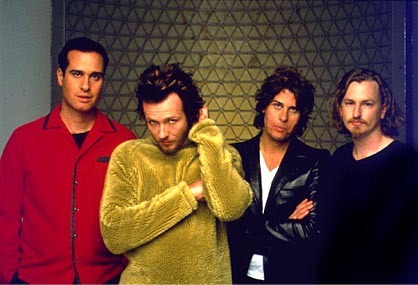
Jane's Addiction


Sound Familiar?
“Jane Says,” “Mountain Song,” “Been Caught Stealing”

Who Are They?
An alternative rock band so important that its initial farewell tour turned into one of the biggest music festivals ever (hello, Lollapalooza).

In the mid-1980s, Perry Farrell was trying (unsuccessfully) to salvage the remains of his pet project, Psi Com. On his search for a new bass player, Perry found Eric Avery and the two bonded over their mutual love for Joy Division and The Velvet Underground. With Eric by his side, Perry changed the name of the band to Jane’s Addiction after his housemate Jane Bainter (who would later be the inspiration for the song “Jane Says”).

After going through three guitarists and two drummers, Jane’s Addiction settled on a permanent lineup of Perry Farrell, Dave Navarro, Stephen Perkins and Eric Avery, and released its self-titled debut in 1987 (recorded live at the Roxy Theatre in Los Angeles).

One year later, Jane’s Addiction actually went into the studio to record its real debut, Nothing’s Shocking (since Jane’s Addiction was a live album, it’s technically not the band’s first album). “Mountain Song,” the first single, featured a slightly controversial music video that MTV refused to play because it contained a scene of full frontal nudity. Without exposure on MTV and modern rock radio, Nothing’s Shocking was initially a commercial failure.

Despite the disappointing sales, Perry and company ended up touring with Iggy Pop and The Ramones, and eventually headlined clubs and theaters.

But the greatest thing (and also the worst thing) to happen to the band was 1990’s Ritual de lo Habitual. From having no recollection of recording the album (so says Dave Navarro, who was battling a crippling addiction to heroin at the time) to beating the shit out of each other on stage, Jane’s Addiction’s most successful album marked the beginning of the end (well, the first time, at least).

The band’s 1991 tour turned into a farewell tour, as everyone realized that they couldn’t stand each other anymore. According to Perry, “That thirteen-month tour behind Ritual was half the reason we wound up unable to stand one another. The other half is that I am an intolerable narcissist who can’t get along with anyone” (from Brendan Mullen's Whores: An Oral Biography of Perry Farrell and Jane's Addiction). 

That tour became the first Lollapalooza festival. Along with Jane’s Addiction, it featured such musically diverse acts as Siouxsie and the Banshees, Ice-T and Nine Inch Nails.

Meanwhile, singles “Been Caught Stealing” and “Stop!” became smash hits thanks to heavy airplay on MTV.

By late 1991, Jane’s Addiction had split into two camps: Dave and Eric vs. Perry and Stephen. Eventually, Dave and Eric decided to quit and the band played its last shows in Australia and Hawaii.

Following the demise of Jane’s Addiction, Perry and Stephen recruited guitarist Peter DiStefano and bassist Martyn LeNoble to form Porno For Pyros in 1992. (Fun fact: Perry named the band after seeing a fireworks ad in a porn magazine.)

Porno For Pyros’ self-titled debut was released in 1993 and the video for the first single, “Pets,” was put into heavy rotation on MTV. The band toured extensively and even made an appearance at Woodstock ’94. (This is one of my favorite Woodstock ’94 sets, so here’s a little taste of it for you.)

The follow-up album, 1996’s Good God’s Urge, reunited Perry and Stephen with Mr. Navarro, and even featured Red Hot Chili Peppers bass pro Flea.

A year later, Jane’s Addiction reunited (minus Eric Avery) and embarked on a fairly successful tour.

Where Are They Now?
Still releasing (somewhat disappointing) new material.

In 2001, Jane’s Addiction embarked on the strange spectacle that was the Jubilee Tour (also known as the “Sexual Psycho Circus”). Porno For Pyros bassist Martyn LeNoble filled in for Eric Avery, who still refused to rejoin the band.

Following the tour, the band finally decided to record a follow-up to Ritual de lo Habitual. Chris Chaney replaced Martyn on bass and Jane’s Addiction went back to the studio for the first time in 21 years. The result was 2003’s Strays.

Another tour followed, but this one was cut short because, let’s face it, these guys can’t get along for an extended period of time. Jane’s Addiction broke up yet again at the end of 2003.

Fast-forward to 2008 when the band reunited yet again at the first ever NME Awards, this time with Eric Avery on board. After that performance, Trent Reznor announced that Jane’s Addiction would accompany Nine Inch Nails on their summer 2009 tour.

After playing the Soundwave Festival in Australia in 2010, Eric left the band for good, stating, “That’s it. With equal parts regret and relief, the Jane’s Addiction experiment is at an end.”

Next in the rotating door of bass players was Guns N' Roses/Velvet Revolver bassist Duff McKagan, who began to work with the band on 2011’s The Great Escape Artist (which is probably one of the most disappointing albums I’ve ever heard, as evidenced by my fairly scathing review).

But of course, Duff left after playing only a handful of live shows (because bassists who join Jane’s Addiction are apparently cursed). TV on the Radio’s Dave Sitek and Strays-era bassist Chris Chaney replaced him.

But Why Jane’s Addiction?
Perry has discussed the possibility of releasing a follow-up to The Great Escape Artist, and there may also be a possible Porno For Pyros reunion!


What Does Sam Think?
I should have written about Jane’s Addiction a long time ago, but I’m more excited about a Porno For Pyros reunion than a new Jane’s Addiction album. Sorry I’m not sorry.

But I’m not saying that I don’t like Jane’s Addiction. I just think this band’s discography can be split right down the middle in terms of quality.

Nothing’s Shocking and Ritual de lo Habitual are stellar records. They kind of set the standards for alternative rock in the ‘90s. That’s what really interesting about this band. Jane’s Addiction technically only released one album in the ‘90s, but ended up becoming one of the bands that defined the entire decade. Most of that has to do with creating Lollapalooza, but looking at the band’s musical contributions, I’ve got to give credit where it’s due.

It’s really hard to pinpoint Jane’s Addiction’s sound without using the word “alternative.” Perry and the gang draw influences from punk rock and heavy metal, but there are also some moments of folk rock ("Jane Says"), psychedelic rock ("Three Days") and a touch of Eastern European gypsy music ("Of Course").

Porno For Pyros expanded on all those extra elements, which made them infinitely more interesting, in my opinion. (Side note: I really urge you to listen to PFP’s self-titled debut. It’s one of my favorite albums of the ‘90s.)

But the later Jane’s Addiction albums (Strays and The Great Escape Artist) don’t capture the free-form feel of those first two albums. It’s so frustrating because I know this band is creative, but this new shit just doesn’t reflect that.

Perhaps a Porno For Pyros reunion can reignite that creative spirit? What do you say, Mr. Farrell?


-- Sam Boyer, reporting from the ‘90s.

Wednesday, November 28, 2012

Marcy Playground


Sound Familiar?
“Sex and Candy”

Who Are They?
Classic ‘90s one-hit-wonders responsible for one of the most frequently asked questions of the decade: “What the hell is disco lemonade?”

Marcy Playground (named after the elementary school front man John Wozniak attended) achieved success early on with its debut self-titled album and this little ditty called “Sex and Candy.” Prior to the band’s formation, John had already recorded an album of his own called Zog BogBean – From the Marcy Playground in 1990. Two songs from that record (“Our Generation” and “The Dog and His Master”) would appear on later Marcy Playground albums.

After attending notable liberal arts school Evergreen State College, John moved to New York and hooked up with his pal Jared Kotler. Once bassist Dylan Keefe joined the band, Marcy Playground began to play shows in NYC and eventually signed to Capitol Records in 1995. Unfortunately, John and Jared couldn’t get past their personal problems, so Jared split and Dan Rieser stepped in just in time to record Marcy Playground in 1997.

The album’s first single, “Poppies,” failed to make a splash, but once “Sex and Candy” hit the radio waves, the band’s popularity skyrocketed. (Fun fact: “Sex and Candy” knocked Oasis’ “Wonderwall” out of the number one spot on Billboard’s Modern Rock Tracks list.)

But what does “Sex and Candy” mean, you ask? Well, according to John, the title is a reference to an evening he spent in his girlfriend’s dorm room when he was 17. The girl’s roommate walked into the room and said, “Oh, it smells like sex and candy in here!” John liked the phrase, so that’s why we have a song called “Sex and Candy.” As for the meaning behind the lyrics, your guess is as good as mine. (But according to Urban Dictionary, “disco lemonade” is actually a tasty cocktail made with vodka and lemonade.)

Marcy Playground released its follow-up, Shapeshifter, in 1999. The album didn’t do nearly as well as its predecessor (hence why the band is considered a one-hit-wonder), and Marcy Playground went on a short hiatus.

(Fun fact: The cover art for Shapeshifter had originally been conceptualized by Paul Leary of Butthole Surfers for the Surfers’ aborted project After the Astronaut. After the artwork was used without permission, Paul was ready to fight. Fortunately for John and company, it was Capitol Records who had stolen the artwork, not the band, so Paul let it go and John had a mini fanboy moment when he realized that a member of Butthole Surfers had designed one of his album covers.)

Where Are They Now?
Touring till death do them part.

After a brief hiatus, Marcy Playground released its third studio album, MP3, in 2004. It didn’t achieve mainstream success, but “Deadly Handsome Man” was featured on the Jay and Silent Bob Strike Back soundtrack and “Punk Rock Superstar” was featured on an XBox 360 playlist.

But the boys remained positive about their future in music, especially on the track “Hotter Than the Sun,” in which John reflects on the band’s short success.

Leaving Wonderland…In a Fit of Rage followed MP3 and Marcy Playground began touring along the California coast.

Lunch, Recess & Detention, a collection of rarities, b-sides and new material, new released earlier this year. Marcy Playground spent the summer touring in support of it alongside fellow ‘90s heavyweights Everclear, Sugar Ray, Lit and Gin Blossoms on the Summerland Tour (which I had the privilege of attending).

But Why Marcy Playground?
There’s the album, the tour and the band’s determination to keep touring no matter what. These guys have another album or two in them. Just wait.


What Does Sam Think?
I have a soft spot for most ‘90s one-hit-wonder bands, mostly because a lot of them deserve more than one hit. Marcy Playground is number one on that list.

“Sex and Candy” is one of the best songs of the ‘90s (though it was ranked criminally low on VH1's list). It’s simple, but murky and just plain sexy. The band’s debut album as a whole is pretty quiet and minimalistic, and I think that really works to its advantage. The late ‘90s was chock full of post-grunge bands wanting to be as loud as possible and Marcy Playground was a welcome alternative to that mindset.

Marcy Playground was heavily influenced by bands like Van Morrison and Nirvana, and you can definitely hear that on each album. The band’s music is a little dark, but not the black metal kind of dark; it’s the art school kind of dark.

As far as live performances go, these guys definitely know who their audiences are. They make light of being one-hit-wonders and always, always play “Sex and Candy” at least once (they usually let the audience sing it a few times). Seeing them live actually prompted me to listen to the rest of their discography, which is pretty solid.

So will Marcy Playground come back to rock radio with a vengeance? Probably not. But I think this band has some more secretly great music up its sleeve. And if these boys continue to tour in support of that new music, they will always have a faithful audience.

If you tour, they will come.


-- Sam Boyer, reporting from the ‘90s.
Wednesday, May 23, 2012

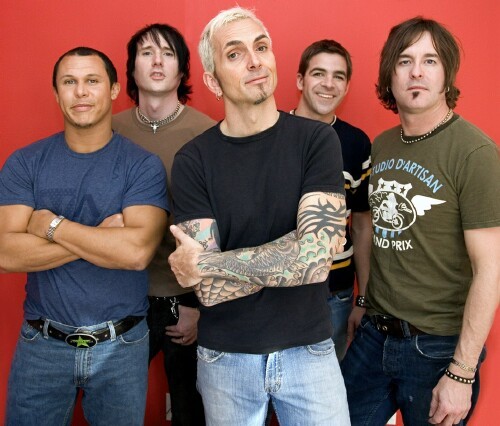
Everclear


Sound Familiar?

“Santa Monica,” “I Will Buy You a New Life,” “Father of Mine”

Who Are They?

One of the most radio-friendly alternative bands of the ‘90s.

Singer and guitarist Art Alexakis started Everclear as an escape from his troubled upbringing. Art’s family faced significant financial hardships and was eventually forced to relocate to the slums of Los Angeles. During this time, Art found solace in heavy drug use, which escalated to a near-fatal cocaine overdose.

After that wake up call, Art turned to music. He played in a short-lived band called Shakin’ Brave in the late ‘80s, but eventually got sick of the Los Angeles music scene and moved to San Francisco.

The big thing in San Francisco at that time was this phenomenon called cowpunk. It’s basically a fine mixture of punk rock and county/blues. If you’re a little confused as to how a genre like this could exist, I’ve got two words for you: Social Distortion.

So what did Art do when he discovered cowpunk? Why, he started a cowpunk band, of course.

Not only did Art start a band called Colorfinger, but he also founded his own record label, Shindig Records. Go big or go home, right?

Unfortunately, Shindig Records failed after only one month. On top of that, Colorfinger broke up and Art found out his girlfriend was pregnant. So he and his girlfriend moved to Portland and Art did what most lone musicians do in a new city – he placed an ad in a local newspaper.

The ad earned him two responses: bassist Craig Montoya and drummer Scott Cuthbert. After settling on the name Everclear (after the infamous grain alcohol), Art and the gang recorded their first independently-released album World of Noise in 1993.

The record didn’t sell. Shocking, isn’t it? Art realized his mistake and began searching for a major label deal. Before scoring the big deal, Scott Cuthbert ditched the band and was replaced with Greg Eklund. Gary Gersch signed Everclear to Capitol Records in 1994 and the band released their major label debut, Sparkle and Fade, the following year.

(Does the name Gary Gersch sound familiar to you? It should. He’s the man responsible for signing Nirvana, Sonic Youth and Counting Crows to DGC Records. He’s kind of a big deal.)

Sparkle and Fade initially didn’t find an audience. Though the first single, “Heroin Girl,” received modest airplay on MTV, it was overlooked by the mainstream.

And then “Santa Monica” happened.

Mainstream audiences went gaga over “Santa Monica,” thanks to the budding alternative radio format. Sparkle and Fade achieved platinum status, but the last two singles (“Heartspark Dollarsign” and “You Make Me Feel Like a Whore”) failed to find the same success.

By 1996, Everclear was struggling to come up with a follow-up. They also had to endure the inevitable comparisons to Nirvana, as most alternative ‘90s bands did.

So Much for the Afterglow was released in late 1997 to an initially lukewarm response. The first two singles (“Everything to Everyone” and “I Will Buy You a New Life”) performed modestly, but that was the least of the band’s troubles.

Everclear’s 1998 Australian tour was an utter disaster. Shoes and explosives were thrown onstage (knocking Art’s teeth loose and burning a stagehand) and Craig Montoya’s acoustic bass was stolen. The band has yet to return to Australia, though Art maintains that he has no bad memories of the country. (I wouldn’t want to return to a country whose fans throw lit explosives onstage. Maybe that’s just me.)

Following a US tour with fellow ‘90s favorites Marcy Playground and Fastball, Everclear released So Much for the Afterglow’s most successful single “Father of Mine.”

Where Are They Now?

Still touring and releasing music with a brand new lineup (minus Art).

After the success of So Much for the Afterglow, Art decided to work on some solo material, which eventually turned into another Everclear project. Songs from an American Movie, Vol. 1: Learning How to Smile (released in 2000) was a heavily pop-influenced record with the monstrous hit single “Wonderful.” (Fun fact: “Wonderful” was used as the graduation song for the Columbine High School class of 1999, just months after the Columbine Massacre.)

The band decided to forgo a tour in favor of releasing a second album that same year. Songs from an American Movie, Vol. 2: Good Time for a Bad Attitude ended up being released just four months after Vol. 1, which resulted in some intense confusion. Not only did Vol. 2 come out way too early, but it also had a completely different sound compared to Vol. 1.

The somewhat awkward decision to tour with Matchbox 20 made the situation even worse. When you’re trying to promote a hard rock album, touring with a predominately pop-rock band isn’t the best idea.

Following the release of Slow Motion Daydream in 2003, Craig and Greg had enough of Everclear and left the band, leaving Art as the only original member. Everclear left Capitol Records one year later.

Craig and Greg both formed other bands after parting ways with Everclear. Craig founded Tri-Polar and Greg founded The Oohlas.

Art concentrated on a solo career before handpicking a brand new Everclear lineup consisting of bassist Sam Hudson, guitarist Dave French and drummer Eric Bretl in 2004. After signing to Eleven Seven Music, the “new” Everclear released Welcome to the Drama Club in 2006.

The band has since cycled through several different drummers and traveled to Iraq in support of the troops.

But Why Everclear?

Their first album in six years, Invisible Stars, in set to drop next month! And if that wasn’t enough, Art and company will embark on a huge tour this summer with Sugar Ray, Lit, Marcy Playground and the Gin Blossoms. Is that ‘90s enough for you?


What Does Sam Think?

I will admit that Everclear kind of sounds like most of the other post-Nirvana bands of the ‘90s (they even toured with most of the mainstreamers of the decade). And post-‘90s Everclear is a little too poppy for my liking.

But in its heyday, this band was everywhere, and for good reason.

Listen to anything from Sparkle and Fade or So Much for the Afterglow. The songs may be radio-friendly, but the subject matter is almost as dark as an Alice In Chains record.

As I noted above, Art Alexakis had a pretty rough childhood. While that’s not uncommon for a musician in any genre, it gave Art the ammo to attract a wider audience. He details his struggles with drugs, money and his absent father under the guise of catchy pop tunes. And it’s not like he made the references cryptic. Listen to “Father of Mine.” The lyrics say it all:

Father of mine
Tell me, how do you sleep
With the children you abandoned
And the wife I saw you beat?

The blow may be softened by the upbeat guitar melodies, but the message is clear. I think that’s what made Everclear so popular. They took these deeply personal experiences and put them in an accessible package.

Are they the greatest band of the ‘90s? Not even close. But do they have some great songs? Yes, they do.

The alternative scene in the ‘90s was massive and its influence has spilled over into the new millennium. Yeah, the sound has morphed a bit and become exponentially more mainstream, but maybe we’ll get back to those “low end of the dial” roots someday. Until then, we’ll have to endure another few Maroon 5 records.


-- Sam Boyer, reporting from the ‘90s.